First-hand Experience
25+ years building companies across three business model eras(Co-founded Backupify (acquired by Datto) and UnifyCX (6,000+ employees), now building AI-era companies through Scalable Ventures)How Did 20th-Century Business Models Make Money?
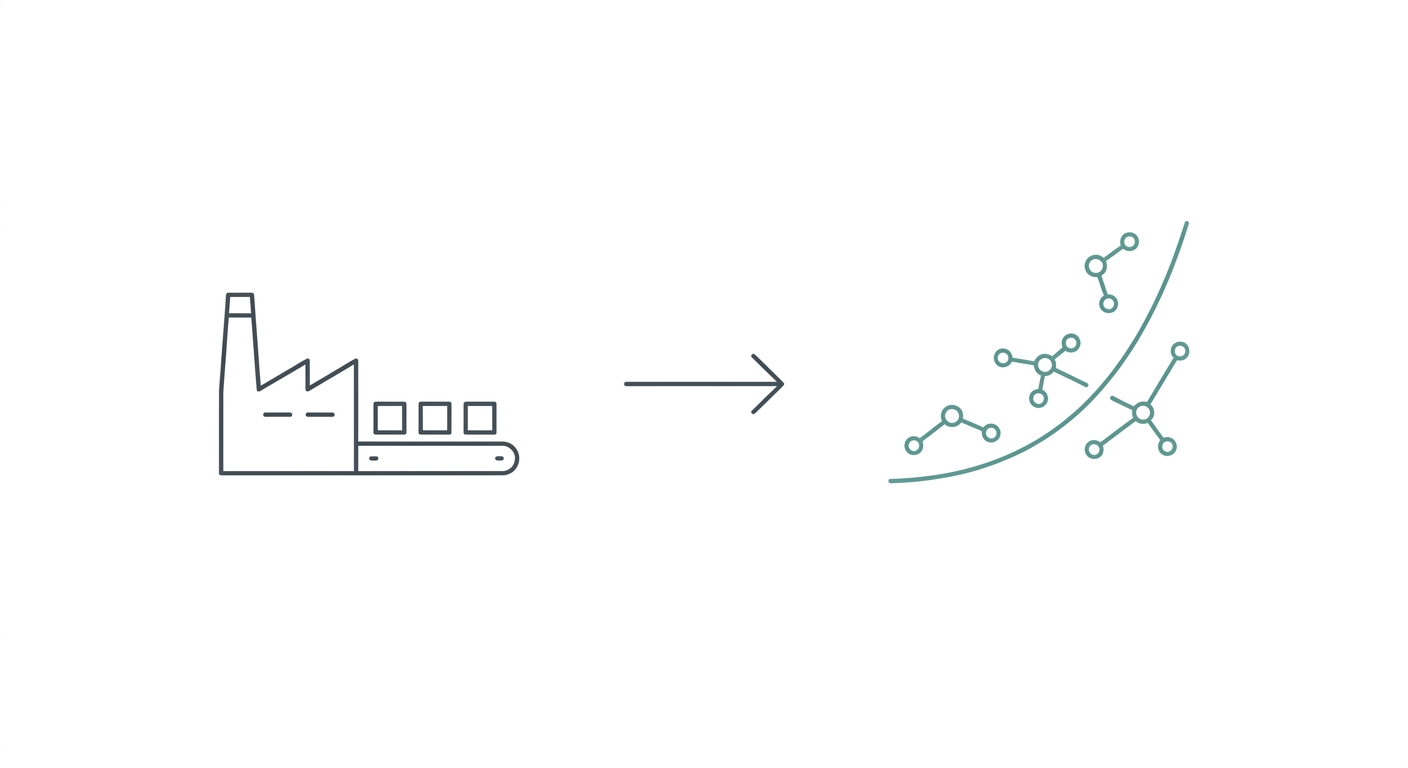
- Growth required proportional inputs. Doubling output meant something close to doubling plant, equipment, and headcount. There were economies of scale, but they flattened. No factory got meaningfully cheaper to run because the previous million units had been produced.
- The constraint was capital. Because growth meant assets, the scarce resource was money to buy them. This is why the 20th century belonged to whoever could finance the most capacity — and why banks and public markets sat at the center of the economy.
- The moat was physical. Competitors had to replicate your factories, your distribution network, your shelf space. That took years and fortunes, which made incumbency durable.
What Did Software Change About Making Money?
What Makes an Exponential Business Model Different?
- The data loop. Usage generates proprietary data; the data improves the model; the improved product wins more usage. This is the AI-era version of a network effect, and it is buildable in markets far too small or unglamorous for classic network effects to form. HiveDesk, one of our portfolio companies, runs on exactly this: custom models trained on years of workforce scheduling data — shift patterns, preferences, compliance constraints — that no generic tool can replicate. The scheduling engine is not a feature bolted onto the product. It is the business model: customers pay for decisions, and every customer makes the decisions better.
- The leverage loop. AI absorbs work that previously required hiring, so growth stops pulling headcount along with it. Revenue scales against compute, which gets cheaper on a curve, instead of against salaries, which get more expensive on one. I have written a whole essay on what this does to org design in Blueprints for the 10-Person Unicorn, so I will not repeat it here — the point for this essay is that the tiny team is a consequence, not the cause. The cause is a business model in which the cost side simply no longer moves with the revenue side.
- The outcome loop. When AI does the work, you can price the result instead of the tool. The industrial era priced units. The SaaS era priced seats — access to a tool, with the customer still supplying the labor. The exponential era increasingly prices outcomes: resolved tickets, qualified meetings, completed workflows. This is the most underrated shift of the three, because it changes who captures the productivity gain. A seat-priced product hands most of the AI dividend to the customer. An outcome-priced product splits it.
How Do You Tell a Linear Business in Exponential Clothing?
- Does the marginal customer make the product better, or just the revenue bigger? If nothing compounds — no data loop, no network, no accumulating advantage — you have a linear business with good margins, which is fine, but price and plan accordingly.
- What does growth pull along with it? If every new revenue milestone has a hiring plan attached, the cost side is still industrial no matter what the product is made of.
- What are you actually billing for? Hours and seats are proxies for value. Every era's transition has been a repricing from proxy to something closer to the value itself. If AI cuts the customer's effort by 80% and you charge by the seat, your revenue just volunteered for the cut.
- Where does the moat accumulate? Assets depreciate. Data, distribution, and trust can appreciate. Ask what gets more valuable each month the company operates — if the answer is "nothing, we just have more customers," the moat is a queue, not a wall.
- Would your current profit pool veto your best idea? This is the Kodak question, and it is uncomfortable on purpose. If the honest answer is yes, the risk to your company is not a competitor. It is your own P&L.
What Should Founders Take from the Shift?
- Choose your business model as deliberately as your product. Write down, in one sentence each, how you create value, how you deliver it, and how you capture it — then ask which decade each sentence belongs to. Most founders discover their product is from 2026 and their capture mechanism is from 2006.
- Design at least one compounding loop from day one. Data, network, or leverage — pick the one your market allows and instrument it. A loop bolted on at scale almost never turns; the data schema, the pricing, and the customer promise all have to be shaped around it early.
- Price the outcome, or at least start the migration. You do not have to leap from seats to outcomes overnight; hybrid structures (platform fee plus usage, base plus success fee) let you learn what customers will accept. But if your pricing model assumes the customer supplies the labor, its clock is running.
- Let the model set the org, not the reverse. Headcount plans, fundraising size, even geography are consequences of the business model. The reason we can build companies on 40 to 60 percent less capital inside the venture studio is not frugality as a virtue — it is that exponential models simply need less input per unit of progress, and raising like a linear company forces you to spend like one.
- Assume the next transition is already underway. The gap between eras is shrinking — roughly eighty years of industrial dominance, thirty of packaged software, fifteen of SaaS. Whatever loop you build, hold it loosely. The founders who survived each previous shift were not the ones with the best version of the old model. They were the ones willing to cannibalize it first.
Related Reading
- Blueprints for the 10-Person Unicorn - The org design consequences of exponential models
- What Scaling a 6,000-Person Outsourcing Company Taught Me - Living through the end of labor arbitrage
- AI Strategy for CEOs - Deciding where AI earns its keep inside an existing company
- The Venture Studio Model - How we build capital-efficient companies around these loops
Rethinking How Your Company Makes Money?
- See the models in action: Explore portfolio companies built around compounding loops
- Access frameworks: Download templates and tools for capital-efficient company building
- Learn how I work: Read more about my approach to building and backing companies
- Talk it through: Reach out to pressure-test your model
